Birds chirping, family and friends talking, a favorite tune on the radio: Not only does our range of hearing allow us to perceive a range of sounds that enrich our lives every day, but it can also be a useful tool in catching the first signs of hearing loss. By understanding the range of human hearing range and the types of sounds we are able to hear, we can better protect our ears to experience the astonishing full range sounds in our world.
Every sound we hear begins as sound waves or vibrations which enter our ear canals and are transformed into signals that our brains can understand and translate. However, instead of processing every single sound wave around us at all times, the human brain has developed an audible frequency range, also known as the human hearing range, to register sounds within specific frequencies.
Generally, the range of human hearing spans 0 decibels (dB) to 120-130 dB. The human hearing range in Hz (hertz) usually includes sounds between 20 Hz and 20,000 Hz (20 kHz). While the upper limit for the average adult is 20,000 Hz, the highest-pitched sounds most people can hear fall between 15,000 to 17,000.
Human infants can actually hear slightly above standard human hearing frequency range, picking up on some frequencies over the 20,000 Hz limit. However, they usually lose that high-frequency perception as they grow older.
While 20 to 20,000 Hz is considered to be the normal human hearing frequency range, this set of numbers isn’t the same for everyone—the frequency range of human hearing can change depending on age, continued exposure to loud noises or other hearing loss risk factors. As we age, the upper limit of the human range of hearing can decrease to around 14,000 Hz or lower.
Because everyone’s hearing range is slightly different, there is not an absolute cut-off point between the normal hearing range and sounds below the lowest audible frequency. However, the human hearing range is generally thought to start at the lowest hertz humans can hear: 20 Hz. Anything below that frequency is considered infrasound. While these sounds are beyond the lowest frequency humans can hear, there are many sources that both produce and perceive sound in this range.
Infrasound sources are often found in nature, with forces of nature, such as volcanoes, avalanches, wind, thunder, waterfalls and earthquakes all produce infrasonic waves. Many animal species use this type of sound for communication, such as elephants, whales, giraffes and alligators. While we cannot hear them, some human activities, such as propellers of large ships, sonic booms and low-speed wind turbines, can also produce infrasonic sound waves.
On the other end of the spectrum, the highest Hz humans can hear is considered to be 20,000 Hz. While this is the highest audible frequency for adults, some children and young adults can hear sounds above this level. Known as ultrasound, this type of sound includes frequencies above the highest frequency humans can hear. Similarly to infrasound, ultrasound is understood and utilized by animals, including bats, whales, dolphins and dogs. For humans, these very high-frequency waves are used in fields like navigation, medicine, imaging, cleaning and communication.
On a dB sound scale, the intensity of everyday sounds and their corresponding dB sound level is arranged in ascending order, giving context to the volume of everyday sounds. Here’s a decibel scale with examples of sounds you might encounter on a regular basis:
To protect our hearing both now and for the future, it’s important to understand safe decibel levels and what sounds can cause harm to our ears. According to the U.S. Environmental Protection Agency and the World Health Organization, sounds at or below 70 dB are considered to be at safe decibel levels for humans. 85 dB is considered to be the maximum level of human sound exposure over eight hours. It’s the threshold at which sounds can begin to cause damage to our hearing, potentially resulting in permanent hearing loss over time.
Sources of 85 dB of noise can be as common as a noisy restaurant, heavy road traffic, vacuum cleaners or a car siren. If your work or hobbies regularly expose you to sounds above this decibel level, consider wearing ear protection to mitigate the risk of hearing loss.
Anyone who’s regularly exposed to loud noises is at risk for experiencing hearing loss. This is especially true for young children, whose ears are still developing and extremely sensitive to loud noises. Just as adults should take precautions to avoid certain decibel levels, there are also safe decibel levels for infants to protect their hearing. As a general rule, babies should not be exposed to sound levels over 60 decibels. A safe decibel level for toddlers and young children is considered about 70 dB, with a maximum decibel exposure of 120 dB.
In recent years, white noise machines have become popular tools for helping infants sleep through the night. These machines can be useful and effective for young children, but can also cause negative impacts on hearing health if used incorrectly. If set to the safe decibel levels for infants, white noise machines can help soothe a crying or restless baby without adverse hearing side effects.
By prioritizing healthy and safe hearing environments for your child, you can take meaningful steps to protect their hearing for the future.
Join the millions of Americans who have trusted Miracle-Ear for hearing care that’s tailored to their needs.
In order for a sound to be heard, it must be above a certain level, known as the auditory threshold. The human hearing threshold is generally about 0 dB, with the range going up to about 130 dB. If a person experiences hearing loss, that threshold of hearing becomes higher and the range of sounds that can be heard shifts. Hearing loss ranges from mild to moderate to severe, and where the ability to hear begins and ends on that range is highly individual. Here you can find the different degrees of hearing loss with respective hearing loss range:
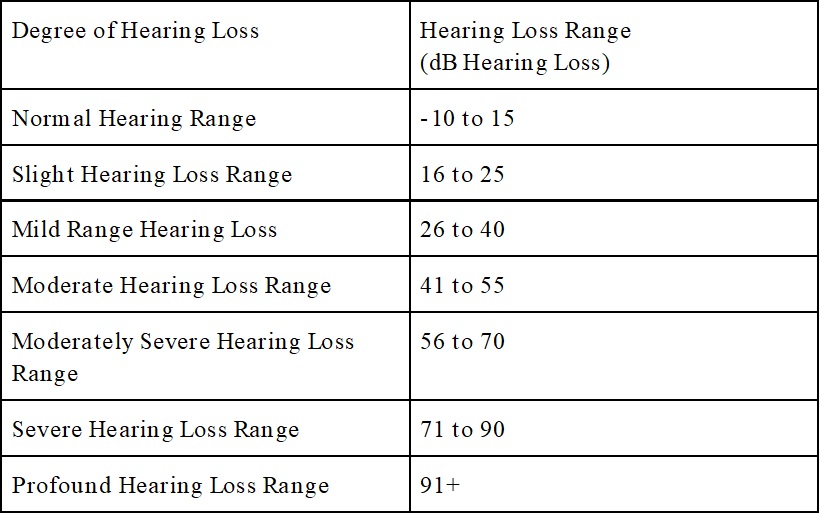
This range, in combination with Hz, can help determine the degree of hearing loss you have in each ear.
If you’ve noticed a change in your hearing, or suspect you’re unable to hear sounds at specific decibel levels, a hearing range test can help determine your current hearing level. Also known as an audiogram, a hearing test is conducted by a hearing care professional (HCP) and measures your ability to hear variations in dB and Hz. Your audiogram will test hearing to determine the decibel level at which you can hear specific frequencies, establishing your hearing threshold.
The hearing test frequency range will generally focus on testing frequencies between 250 Hz and 8,000 Hz, or more, as needed. Once your test is complete, your hearing care professional (HCP) will review the audiogram with you to understand the results and what your specific degree of hearing loss is. Your HCP is not only a great resource for testing hearing—they can also guide you along your hearing health journey, helping you determine the necessary next step to help you hear to the fullest.
If you’ve noticed a change in how well you’re able to hear a range of sounds, schedule an appointment at your local Miracle-Ear to speak with a hearing care professional and test your hearing today.



 Meet with a licensed expert
 Schedule your free hearing test