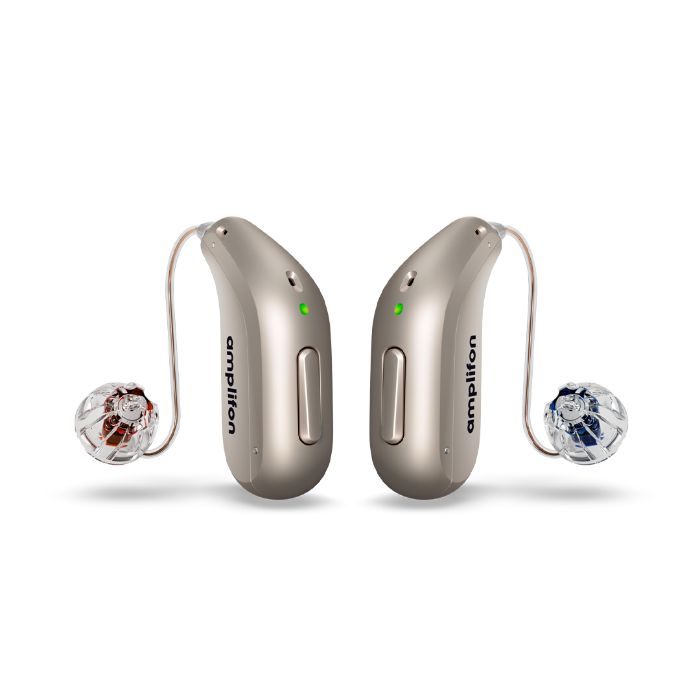
Designed for people with hearing loss in one ear that can't be treated with traditional hearing aids, our CROS and BiCROS hearing aids offer better all-around hearing. In CROS and BiCROS hearing aids, a CROS RIC transmitter is worn behind the unaidable ear.
It detects sound, processes it, and transmits it to the hearing aid on the other side, allowing the wearer to hear sounds from both sides. Significant amounts of sound that otherwise would be lost are captured and delivered in a way the user can understand.
Join the millions of Americans who have trusted Miracle-Ear for hearing care that’s tailored to their needs.
While both hearing aids are for people who have unaidable hearing loss in one ear, CROS hearing aids are for people who have normal hearing in their other ear, while BiCROS hearing aids are for those who have asymmetrical hearing loss, where both ears experience hearing loss but to differing degrees. Both feature a transmitter on the non-hearing ear to pick up sounds from that side. However, a CROS hearing aid just features a simple receiver on the good ear to receive and deliver sound, while a BiCROS system’s receiver also amplifies sound from both sides.
We offer solutions that transform hearing, from nearly invisible, comfortable designs to robust AI technology.

CROS system

BiCROS system
CROS and BiCROS hearing aid reviews
*Reviews may be edited for spelling and grammar
Learn more about how your hearing works from certified experts.
Below are some of the pros and cons of CROS hearing aids.
Pros:
Cons:
Below are some pros and cons of BiCROS hearing aids.
Pros:
Cons:
At Miracle-Ear, CROS and BiCROS hearing aids have a similar (though slightly higher) price range to regular hearing aids. However, prices vary by location. Visit your local Miracle-Ear store for more detailed pricing information on the system that best suits your specific hearing loss needs.
Hearing aids are sometimes covered by insurance, and sometimes not—and the same goes for CROS and BiCROS hearing aids. Coverage depends on your plan, the state in which you live, and the specific details of your hearing loss. To get the most accurate information for your situation, call your insurance provider for details on the coverage they offer for hearing aids.
* Customer reviews may be edited for spelling, grammar, or length. The original meaning and sentiment remain unchanged.




 Ready to experience the difference for yourself?


.jpg/jcr:content/renditions/cq5dam.web.700.700.jpeg)

 Our licensed experts will help you with any questions you may have