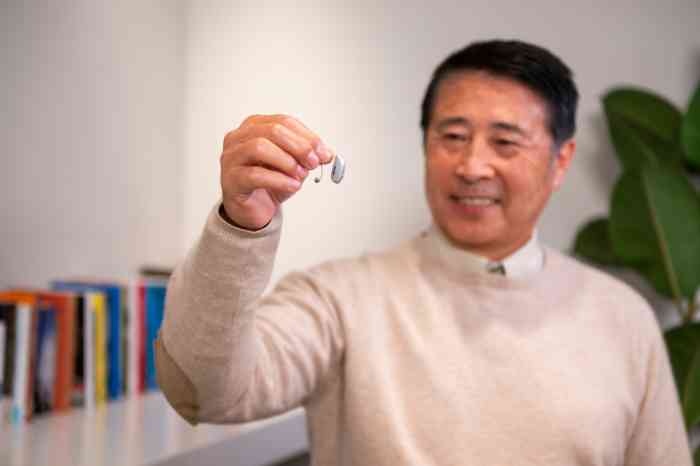
When you're shopping for hearing aids in 2025, the options you'll find can be divided into two main categories: Over-the-counter (OTC) and prescription.
OTC hearing aids are those sold in a retail store or online without the need for a hearing exam or a prescription. In contrast, prescription hearing aids are fitted to your ears and customized to your specific level of hearing loss and lifestyle needs. They also require a visit to a doctor or hearing care professional who will evaluate your hearing before fitting you with hearing aids.
Here, Miracle-Ear Chief Audiologist Dr. Thomas Tedeschi unpacks the differences between the two types of hearing aids and what to consider when you're shopping.
According to the American Academy of Audiology, OTC hearing aids are “devices that amplify sound and can be purchased without professional support and without a hearing test."1
These devices have grown in popularity since the Food and Drug Administration (FDA)2 approved the sale of over-the-counter (OTC) hearing aids for adults with perceived mild to moderate hearing loss in the fall of 2022. Features of OTC hearing aids include:
The customization process is more than simply going in for a hearing screening. It also includes:
Prescription models also have an extensive range of features and are designed to help people with all levels of hearing loss, from mild to severe. Many prescription hearing aids include advanced features and technology that enhance conversations within close range, reduce background noise, and offer smart, automatic adjustments for realistic and natural sound quality.
Dr. Tom Tedeschi
From a buyer’s perspective, the difference between OTC and prescription hearing aids may seem subtle. Both are devices that sit in your ears to help you hear better. But, Tedeschi says, “They are two distinct, different devices.” He laid out four key differences that you should consider:
OTC hearing aids are designed for consumers with perceived mild to moderate hearing loss. Since they don't require a hearing test, users may or may not fall within that recommended loss range of between 20 and 60 decibels (dB). 3
Prescription hearing aids, on the other hand, are tuned to each person's individual hearing loss, meaning they can address mild hearing loss all the way up through severe impairment.
OTC hearing aids come in a variety of models, including receiver-in-canal (RIC), in-the-canal (ITC), behind-the-ear (BTE), and in-the-ear (ITE). But that's often where customization ends. Hearing aids are not fitted to the user's specific ears. That can make wearing them long-term uncomfortable or cause sound to escape from the ear, which makes for a subpar listening experience.
Prescription hearing aids also come in this range of hearing aid types and styles—but there are more options within those categories. They may also include custom ear molds and custom-built elements that ensure a perfect fit, minimizing feedback and making all-day wear more comfortable.
One of the best ways to care for your ears and prevent hearing loss is to get them properly examined by a hearing care professional. Find your nearest Miracle-Ear store to get started on your journey to better hearing.
OTC hearing aids come with pre-set programs designed for a wide range of listening environments. Users can self-customize to a certain extent, adjusting things like volume or, on some models, toggling through listening presets for environments like “noisy restaurant” or “watching TV.”
Prescription hearing aids come with significantly more technology-enhanced options, including:
These features are professionally tailored to your specific hearing needs, offering greater precision and flexibility than OTC options.
OTC hearing aids are generally less expensive upfront than prescription versions. They can range from prices as low as $300 up to nearly $2,000.4 Tedeschi recommends steering clear of anything under $399, as quality suffers dramatically at such an ultra-low price point.
The cost of prescription hearing aids starts at around $1,000 and goes up to as much as $6,000 or more. While the price tag is significant, prescription hearing aids come with much more: professional fittings, ongoing care and adjustments, and higher-quality materials and sound processing.
Cost is certainly a factor for many when it comes to deciding between OTC and prescription hearing aids. While there are prescription models that are well within the range of a higher-end OTC version, it's also important to consider total value.
“With OTC hearing aids, you get what you buy,” Tedeschi says. “But you're also getting services [when you buy] a prescription hearing aid.”
These services often include an extensive warranty period and a service period where a professional guides you through a hearing test, fitting, and instructions on how to use the hearing aid. And that's just the up-front care. Aftercare is essential to getting the right fit and best performance from your hearing aids.
“You're generally going to have two follow-up visits right away to make sure everything is going right, or to see if any adjustments need to be made,” Tedeschi says. And over the lifespan of your hearing aids, more adjustments will likely be required as your hearing changes over the years.
Miracle-Ear's lifetime aftercare services include quarterly cleanings and check-ups, ongoing adjustments and repairs, and annual hearing tests. Miracle-Ear customers also get professional aural rehabilitation services to help with the process of rebuilding hearing.
“When you've had a hearing loss for several years, and you put hearing aids in, it's like turning the world back on all of a sudden,” Tedeschi says. “You have to adapt to that, and your hearing care professional can help you … learn to listen again. With OTC, you don't have any of that help or assistance.”
As the OTC hearing aid market continues to expand, more consumers may choose to purchase hearing aids this way. Tedeschi is not totally opposed to the idea, especially since it takes the average consumer about five years to seek treatment for hearing loss.
“They are good entry devices to get people to experiment,” he says.
But before you make the leap into OTC, Tedeschi does recommend booking an exam with a physician or hearing care professional.
Join the millions of Americans who have trusted Miracle-Ear for hearing care that’s tailored to their needs.
“Have them look in your ears first, before you purchase [OTC hearing aids], to make sure that you don't have a great deal of wax buildup or some other type of problem that could be causing this [hearing] issue.”
Tedeschi notes that an OTC hearing aid can remind you what it's like to hear again, and, for many people, that leads to exploring higher-performing prescription options that are customized to their needs. The most important thing is to address hearing loss safely, effectively and sooner rather than later.
“The longer [we] go with hearing loss, we start to lose some function in the inner ear and the brain,” Tedeschi notes. “Sometimes a hearing aid, if you wait too long, can only help so much.”
¹ https://www.audiology.org/advocacy/legislative-and-regulatory-activities/federal-affairs/over-the-counter-hearing-aid-resource-center/over-the-counter-hearing-aid-faqs/
² https://www.fda.gov/medical-devices/hearing-aids/otc-hearing-aids-what-you-should-know#:~:text=To%20increase%20the%20public's%20access,effect%20on%20October%2017%2C%202022.
³ https://www.aarp.org/health/conditions-treatments/info-2022/over-the-counter-hearing-aid-facts.html
⁴ https://www.cvs.com/learn/health/general-health/otc-hearing-aids



 Meet with a licensed expert

 Find your closest Miracle-Ear center