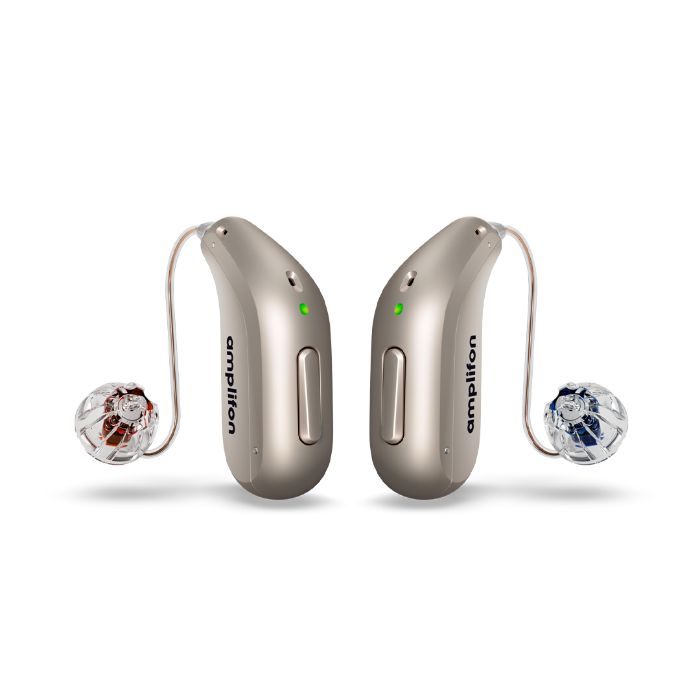
Binaural hearing refers to the ability to use both ears together to process sound. Relying on both ears is essential for effective communication, as it allows us to understand where sounds come from, distinguish faint noises from louder ones, judge distance, and separate a voice from background noise.
Every sound we hear is defined by three main qualities: frequency (pitch), intensity (loudness), and time. Binaural hearing improves clarity in complex environments and makes it easier to follow conversations. It also increases the range at which sounds can be detected, which can be critical for safety, such as noticing a siren or fire alarm from afar.
We offer solutions that transform hearing, from nearly invisible, comfortable designs to robust AI technology.
Binaural hearing loss occurs when both ears are affected, reducing the ability to hear sounds clearly, localize where they come from, or distinguish speech in noisy environments. This condition can develop gradually or suddenly and has several causes, including:
Because binaural hearing loss often develops slowly, many people don’t notice the problem until communication becomes challenging. Early identification is key to choosing the most effective treatment and preserving quality of life.
If you are only treating one ear—or none—it may be time to explore options that re-engage both ears. Untreated binaural hearing loss can lead to:
Visit your nearest Miracle-Ear location for a free hearing test to confirm your hearing loss. Our licensed hearing care professionals can help you find the best option for your hearing needs, lifestyle, and budget.
Binaural hearing tests and electroacoustic evaluation play an important role in assessing how hearing aids perform when both ears are aided simultaneously. Because everyday listening relies on binaural hearing, certain forms of hearing aid evaluation are inherently binaural in nature and are best conducted with hearing aids worn on both ears. These tests examine outcomes such as sound localization, speech understanding in noise, and the integration of acoustic information across ears, which cannot be fully captured through monaural assessment alone.
When performed with hearing aids on, binaural evaluations provide clinically relevant information about real-world performance, including device synchronization, balance between ears, and the effectiveness of binaural signal processing features.
This approach ensures that electroacoustic measures and functional outcomes reflect how the hearing aids work together as a coordinated system rather than as independent devices.

Binaural hearing aids are a pair of hearing aids worn on both ears that work together to support natural, two-ear hearing. They utilize the brain’s natural ability to process sounds from both ears at once, improving balance, clarity, and spatial awareness. These devices work by amplifying sounds and sending them separately to each ear.
Binaural hearing aids often communicate wirelessly, ensuring the sound is balanced and synchronized. For example, if someone is speaking on your left side, the left hearing aid may prioritize that voice while the right one reduces background noise, creating a clear and natural listening experience.
Using two hearing aids improves speech understanding in noisy environments, makes it easier to determine where sounds are coming from, and reduces the need for high volume, resulting in less distortion and greater listening comfort. Wearing aids in both ears also helps prevent auditory deprivation, keeping the brain’s sound-processing pathways active.
Learn more about how your hearing works from certified experts.
Here are some of the benefits of binaural hearing and why you should invest in two hearing aids:
Binaural hearing improves the ability to understand speech, especially in noisy or complex environments. By combining input from both ears, the brain can focus on the target speaker and separate background sounds, making conversations easier to follow.
Using both ears allows sounds to be perceived more naturally and evenly. Binaural hearing ensures that audio is balanced between ears, providing a richer, more realistic listening experience for music, speech, and everyday sounds.
Binaural hearing helps the brain distinguish between different sounds and identify their direction and distance. This improves the ability to tell one sound from another and to detect where sounds are coming from in the environment.
When considering hearing aids, one important choice is whether to treat one ear (monaural) or both ears (binaural). Your hearing care professional will help you select the best option for you, based on your test results.
Never underestimate the importance of ear care, your hearing might depend on it.
Hearing does not happen in your ears but in your brain. Your brain uses information from your ears to decipher sound, as well as provide space perception, depth perception and balance. Binaural hearing, or hearing with both ears, benefits your brain by providing it with a fuller set of stimulus data.
If you’re using one hearing aid when your hearing test indicates that you should be using two, the chances of your brain getting all the information it needs to hear and understand reduces by 50%. It also removes the ability to perceive space and depth.





 Get your free hearing test today

.jpg/jcr:content/renditions/cq5dam.web.700.700.jpeg)