
Have you ever felt like your favorite music doesn’t sound the same anymore? Or every time someone is talking, you’ve caught yourself saying, “What?” again and again? While these may seem like standalone situations that can easily be brushed off, they could also be signs of low-frequency hearing loss.
Low-frequency hearing loss is characterized by the inability or difficulty hearing low tones. It is also commonly known as “reverse-slope” hearing loss. The name comes from audiograms that indicate low-frequency hearing loss with a reverse slope.
This type of hearing loss is rare, but certain circumstances, like age and noise exposure, can increase sensitivity and gradually reduce the ability to hear low frequencies1. In hertz (Hz), humans can generally hear frequencies ranging from 20 Hz to 20,000 Hz2. Some individuals with low-frequency hearing loss cannot hear sounds below 2,000 Hz.
We offer solutions that transform hearing, from nearly invisible, comfortable designs to robust AI technology.
Low-frequency hearing loss is identified by the inability to hear low-pitched sounds. Its symptoms often include difficulty hearing:
Treatment or management resources for low-frequency hearing loss are often available. But first, it is important to know what type of low-frequency hearing loss you have. There are two types of low-frequency hearing loss: sensorineural and conductive.
During the acute stages, sensorineural hearing loss can be corrected with prescription hearing aid treatment, while conductive hearing loss may be corrected by the removal of wax or fluid, though sometimes surgery is required.
However, in the case of chronic hearing loss, the best management solution is hearing aids. To find the best hearing solution, it’s always best to go in for a hearing test and speak with a hearing care professional (HCP) to find options tailored to your hearing needs.
The best hearing aids for low-frequency loss are prescription hearing aids. Audiologists and licensed HCPs can program any prescription hearing aids to amplify the sound of low frequencies you need based on your hearing test results. Through follow-up appointments, your provider can adjust the prescription hearing aids to make your hearing journey more comfortable.
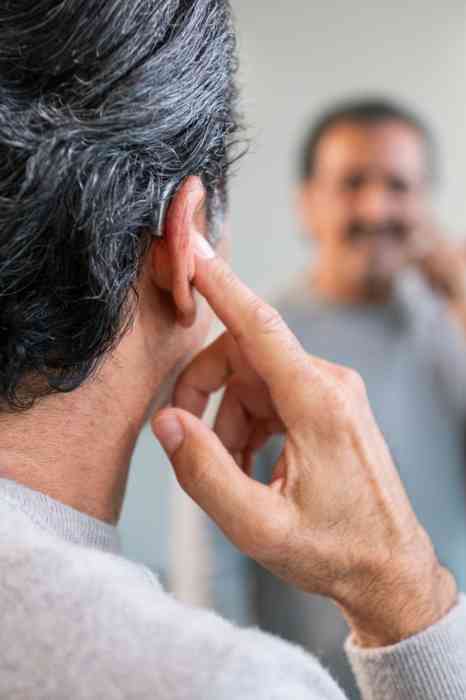
Commonly prescribed hearing aids for low-frequency hearing loss are behind-the-ear (BTE) hearing aids, custom In-the-Ear types, and bone-anchored hearing aids (BAHAs)3. The type you are prescribed depends on the type of low-frequency hearing loss you’re dealing with.
The right kind of hearing aid can make all the difference! Here’s what to look for during your hearing aid search:
1Jin, In-Ki, et al. “Trends in Distributions of Hearing Threshold Levels by Ages: A Comparison of the ISO 7029 and Newly Available Country-Specific Data.” Journal of Audiology & Otology, vol. 28, no. 1, 10 Jan. 2024, pp. 1–9, www.ncbi.nlm.nih.gov/pmc/articles/PMC10808389/, https://doi.org/10.7874/jao.2023.00626. Accessed 22 Apr. 2024.
2Purves, Dale, et al. “The Audible Spectrum.” Nih.gov, Sinauer Associates, 2001, www.ncbi.nlm.nih.gov/books/NBK10924/.
3Tanna, Ravina J., et al. “Sensorineural Hearing Loss.” PubMed, StatPearls Publishing, 2023, www.ncbi.nlm.nih.gov/books/NBK565860/.
4Sooriyamoorthy, Thushanth, and Orlando De Jesus. “Conductive Hearing Loss.” PubMed, StatPearls Publishing, 23 Aug. 2023, www.ncbi.nlm.nih.gov/books/NBK563267/.



 Meet with a licensed expert

 Find your closest Miracle-Ear center