
Hearing loss can happen at any age. However, hearing loss may cause delays in speech, language and social skills during infancy and early childhood. This is why hearing tests for children and infants are important for their development.
Hearing is a sense that develops early on, before a baby is even born. By birth, a baby’s hearing should be fully functioning. However, it’s important to remember that every child is different, and some may reach different milestones at different ages.
Yes, children should have their hearing tested to check for signs of hearing loss. Detecting hearing loss early on is important in helping children get treated more effectively. It can also help prevent developmental delays.
Many people wonder, “At what age should children get an eye and hearing test?” According to the Centers for Disease Control and Prevention (CDC), all babies should be screened for hearing loss no later than 1 month of age1. Ideally, this screening is done in the hospital shortly after the baby is born. This is part of the Universal Newborn Hearing Screenings, a requirement for babies in 43 states.
There are several common causes of hearing loss. In babies specifically, one out of two cases of hearing loss is due to genetics, and one out of four cases is due to maternal infections during pregnancy, according to the CDC.2
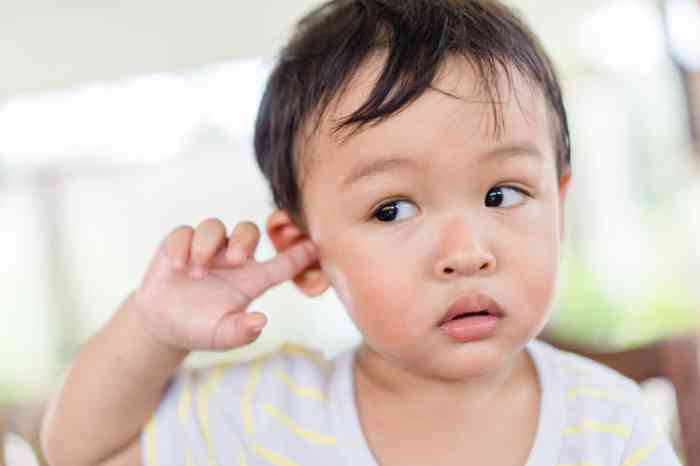
There are several signs and symptoms of hearing loss. Some common signs of hearing loss in babies include:
In children, signs of hearing loss include:
Different hearing tests are recommended at different ages. Newborn hearing screenings typically include otoacoustic emissions test and an auditory brainstem response test. As children get older, tests can include visual reinforcement audiometry, tympanometry, play audiometry, pure-tone audiometry and speech-recognition testing, depending on their age and specific needs. Learn more about these types of hearing tests for children by age, below.
Many people wonder “What hearing test is done on newborns?” Below are a few tests commonly performed on infants within 24 hours of being born in a hospital.
The following hearing screenings are what children usually have when approaching preschool.
Tympanometry is another common hearing test for children. This is a type of test that measures how a person’s middle ear is working—including the eardrum and Eustachian tube. An audiologist will insert a probe into the ear which will emit air pressure and a low sound. This records how the person’s eardrum moves in response to the air pressure, with results displayed on a graph called a tympanogram.
Tympanometry can also measure acoustic reflexes. The stapedius (a tiny muscle in the middle ear) involuntarily contracts when exposed to loud sounds. An acoustic reflex test measures how the middle responds to sound stimuli by testing how loud of a noise is needed to activate this reflex. This test is conducted by inserting a probe into the ear and is another way that hearing loss can be detected in children.
Children are also recommended to get certain hearing tests as they get older. Here are a few other types of hearing tests for children.
Small changes can have a big effect on your hearing health. Hear how you can take action with three simple hearing loss prevention tips that will help protect your hearing.
While Miracle-Ear does not offer testing or sell products to children under 18 years old, the Miracle-Ear Foundation partners with schools to provide hearing tests for students.
Newborn hearing tests can be done while a baby is asleep or resting. Neither OAE nor ABR tests require any cooperation from those being tested.
A hearing screening for a newborn usually takes around 15 minutes to complete3.
When a newborn gets a hearing screening, the results are provided before the family leaves the hospital4. If there are any concerns or abnormalities in the test results, your healthcare professional will advise you on next steps.
What does a newborn failed hearing test mean? It’s important to remember that hearing screenings for newborns are not intended to diagnose hearing loss5. If a newborn fails their hearing screening at the hospital, it means more testing needs to be done. Further testing is usually recommended as soon as possible in order to learn why there are hearing issues and to treat these issues, if necessary.
**Miracle-Ear does not test or sell to people under the age of 18.
1 “Screening for Hearing Loss.” Centers of Disease Control and Prevention. October 8, 2024. www.cdc.gov/hearing-loss-children/screening/index.html
2 “About Hearing Loss in Children.” Centers for Disease Control and Prevention. May 15, 2024. https://www.cdc.gov/hearing-loss-children/about/index.html
3 “Newborn Hearing Screening Information For Parents.” State of Rhode Island Department of Health. Accessed September 9, 2025. https://health.ri.gov/newborn-screening/information/parents-newborn-hearing-screening-information
4 “Newborn Hearing Screening Information For Parents.” State of Rhode Island Department of Health. Accessed September 9, 2025. https://health.ri.gov/newborn-screening/information/parents-newborn-hearing-screening-information
5 “Newborn Hearing Screening Information For Parents.” State of Rhode Island Department of Health. Accessed September 9, 2025. https://health.ri.gov/newborn-screening/information/parents-newborn-hearing-screening-information



 Our experts will help you with any questions you may have
 Find the closest Miracle-Ear center