
Acoustic neuromas are small cranial tumors that affect roughly one to two people per 100,000 annually. While benign, these tumors can cause symptoms that affect quality of life and often require surgery or radiation to reduce or stop growth. Learn what an acoustic neuroma is, plus causes, symptoms and treatment options.
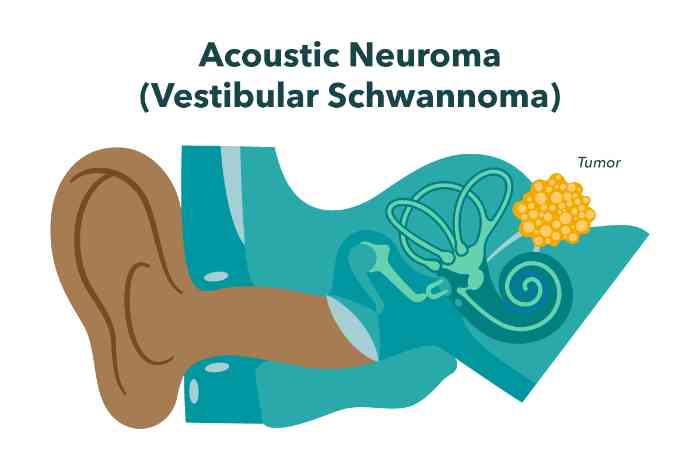
An acoustic neuroma, also known as a vestibular schwannoma, is a tumor that grows in the inner ear. While they are generally benign, acoustic neuroma tumors can become dangerous if left untreated, as they could affect hearing and balance nerves.
Acoustic neuromas can occur on one or both sides. When a tumor is only present on one side, it is considered unilateral. On the other hand, bilateral acoustic neuromas occur on both sides. This type of neuroma is often associated with a condition called acoustic neuroma neurofibromatosis type 2 (NF2), a genetic disorder that may be passed down from family or acquired through mutation1.
Acoustic neuromas form in the inner ear—specifically on the nerve leading from the inner ear into the brain. If left to grow, it can also lead to subsequent damage to the nerves that control balance and face sensation.
Every case is different, but it is not uncommon for symptoms to come and go. As the tumor grows and changes shape, it compresses inner ear nerves in different ways, leading to changes in the intensity and frequency of symptoms.
Acoustic neuromas occur when the body overproduces Schwann cells, which support and insulate the nerves in your inner ear. Some scientists believe this is caused by the loss of function of a specific gene that controls the growth of Schwann cells.1 This may be the case in patients with NF2. However, in many cases, the cause of overgrowth is unknown.
Common acoustic neuroma causes include:
Acoustic neuroma treatment plans vary from person to person based on the size and location of the tumor and the severity of symptoms. Here is an overview of common acoustic neuroma treatment options.
Before acoustic neuroma surgery, symptoms may include hearing loss, dizziness or numbness. These should subside if the tumor can be removed fully. However, surgery comes with the risk of complications, including:
If you experience any of these after acoustic neuroma surgery, your doctor will work with you to determine the best path forward.
Acoustic neuroma is most commonly diagnosed between ages 40 and 604. There are several tests for acoustic neuroma diagnosis, including:
Unilateral (one-sided) acoustic neuromas account for around 8% of all intracranial tumors, while bilateral (two-sided) acoustic neuromas are even more rare, accounting for less than 5% of all cases2 .
Because the causes of acoustic neuroma are generally difficult to determine, acoustic neuroma prevention is not an exact science. In general, following these tips may reduce your risk of developing an acoustic neuroma or help detect one early.
Having an acoustic neuroma doesn’t just affect hearing, balance and the ability to communicate. These symptoms can also affect quality of life, especially mental health. Previous research has shown that acoustic neuroma and depression (as well as anxiety) are closely linked6. Patients may also experience fatigue due to compression on the brainstem.
Learn about these commonly asked questions about acoustic neuroma symptoms, diagnosis and treatment.
An acoustic neuroma cannot directly cause sinus problems. However, it can be difficult to tell the difference between the signs of acoustic neuroma and sinus issues because they share some common symptoms, including:
If you are experiencing any of these symptoms, consult a medical professional to get a clear diagnosis.
While uncommon, it is possible for an acoustic neuroma to return after surgery, especially if the tumor was only partially removed. Most recurrences happen three to five years after surgery, and in some cases, the tumor can regrow after up to 10 years7. This is why regular follow-up appointments are necessary after acoustic neuroma surgery.
Although radiosurgery treatment has a high success rate, recurrence is also possible with this method. The good news: A 2021 study showed that repeat radiosurgery after a failed attempt is associated with high tumor control rates8.
1. National Institute on Deafness and Other Communication Disorders. “Vestibular Schwannoma (Acoustic Neuroma) and Neurofibromatosis.” NIDCD, 18 Aug. 2015, www.nidcd.nih.gov/health/vestibular-schwannoma-acoustic-neuroma-and-neurofibromatosis.
2. Greene, Joshua, and Mohammed A Al-Dhahir. “Acoustic Neuroma.” Nih.gov, StatPearls Publishing, 17 Aug. 2023, www.ncbi.nlm.nih.gov/sites/books/NBK470177/.
3. G. Dupic, et al. “Stereotactic Radiosurgery for Vestibular Schwannomas: Reducing Toxicity with 11 Gy as the Marginal Prescribed Dose.” Frontiers in Oncology, vol. 10, 29 Oct. 2020, https://doi.org/10.3389/fonc.2020.598841.
4. Concheri, Stefano, et al. “Prognostic Factors for Hearing Preservation Surgery in Small Vestibular Schwannoma.” Audiology Research, vol. 13, no. 4, 3 July 2023, pp. 473–483, https://doi.org/10.3390/audiolres13040042.
5. Deltour, Isabelle, et al. “Exposure to Loud Noise and Risk of Vestibular Schwannoma: Results from the INTERPHONE International Case‒Control Study.” Scandinavian Journal of Work, Environment & Health, vol. 45, no. 2, 5 Nov. 2018, pp. 183–193, https://doi.org/10.5271/sjweh.3781.
6. Younes, Samira, et al. “Psychiatric Disorders in the Acoustic Neuroma: About a Case.” The Pan African Medical Journal, vol. 33, 4 June 2019, p. 80, www.ncbi.nlm.nih.gov/pmc/articles/PMC6689850/, https://doi.org/10.11604/pamj.2019.33.80.18398.
7. Scheer, Maximilian, et al. “Recurrences and Progression Following Microsurgery of Vestibular Schwannoma.” Frontiers in Surgery, vol. 10, 21 June 2023, pmc.ncbi.nlm.nih.gov/articles/PMC10322218/, https://doi.org/10.3389/fsurg.2023.1216093.
8. Balossier, Anne, et al. “Repeat Stereotactic Radiosurgery for Progressive Vestibular Schwannomas after Previous Radiosurgery: A Systematic Review and Meta-Analysis.” Neurosurgical Review, vol. 44, no. 6, 13 Apr. 2021, pp. 3177–3188, https://doi.org/10.1007/s10143-021-01528-y.


 Start your journey towards better hearing

 Check your hearing health in our centers